The Economics of Coding Agents in Legacy Systems
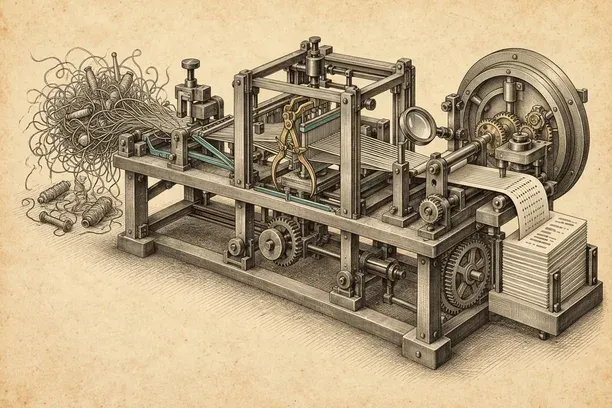
In a greenfield application, persistent state is empty, module boundaries have no external dependents, and mistakes are cheap to reverse. Under those conditions, optimizing for raw code-generation speed makes economic sense: an unconstrained coding agent can scaffold features rapidly because verification cost is low and the blast radius of a flawed assumption is minimal.
In a mature, revenue-generating system, such as a multi-year payment and settlement service, those conditions invert. Changes must preserve implicit cross-service invariants, reconcile existing ledger state, and pass review by a finite pool of senior engineers who understand the system’s failure modes. Lowering the cost of generating code without bounding scope does not eliminate engineering cost; it shifts cost downstream into coupling, review queues, rework, and expected incident loss.
Programming With a Loom and Unit Economics
In Simple Made Easy, Rich Hickey distinguishes easy (low friction to start authoring) from simple (low coupling between state, time, and business rules). Coding agents collapse authoring friction, but when left unconstrained in an iterative loop, they optimize for immediate local pass criteria, braiding shared helpers, state transitions, and test assertions together in what Hickey called “programming with a loom.” As Donald Reinertsen shows in The Principles of Product Development Flow (Pt. 1), optimizing a proxy variable like lines generated per minute while ignoring downstream holding and verification costs degrades total system performance.
Economic Trade-Off: Authoring Cost vs. Complexity Cost
Figure 1: Agent autonomy follows a U-curve optimization between declining Authoring Cost and rising Complexity & Coupling Cost, reaching minimum total cost at small, bounded steps.
Where a task lands on this curve depends on four things:
- Files and shared helpers touched: Whether edits stay within a single module or alter shared utilities imported by sibling services.
- State transitions modified: Whether the diff changes database schemas, lock acquisition order, or asynchronous retry state.
- Invariants affected: Whether idempotency, ledger balancing, or external partner contract assumptions are in scope.
- Expected review effort: The senior engineering time required to verify that every touched path preserves production behavior.
The useful measure is total cost per accepted change, not token spend per diff:
Cost per Accepted Change = Generation + Rediscovery + Senior Review + Rework + Cost of Delay + (Incident Probability × Incident Loss)
The table below uses illustrative planning assumptions (assuming a $150/hr loaded senior engineering rate and an illustrative $20,000 incident cost when a settlement invariant breaks) to show how token generation cost is dwarfed by downstream review, rework, and risk exposure:
| Cost Component | Unconstrained Repo-Wide Loop (Illustrative) | Bounded Harness Step (Illustrative) |
|---|---|---|
Generation (C_gen) |
$6–$15 in raw model tokens | $2–$5 in scoped model tokens |
Rediscovery (C_rediscovery) |
$10–$25 across repeated search/compaction | $1–$3 via indexed graph context |
Senior Review (C_review) |
$225 (90 min auditing cross-module side effects) | $50 (20 min verifying a contract-bounded diff) |
Rework (C_rework) |
$150 (60 min fixing broken callers or tests) | $25 (10 min minor revision; bad runs gated) |
Queue Delay (C_delay) |
$300 (multi-day wait in review bottleneck) | $40 (same-day review of small batch) |
Expected Incident (p × L) |
$400 (2.0% probability × $20,000 loss) | $40 (0.2% probability × $20,000 loss) |
| Illustrative Total / Change | ~$1,095 per accepted change | ~$160 per accepted change |
In practice, production pull-request telemetry mirrors these planning assumptions. When tracking agent-assisted changes across a mature transactional codebase over a 60-day window, total cost diverges sharply along a single boundary: whether the agent was permitted to modify shared helpers and cross-module state transitions, or restricted to a single contract-bounded module.
| Observed PR Cohort (60-Day Sample) | Scoped Harness (1–2 files, single module) | Unbounded Loop (5+ files, shared helpers touched) |
|---|---|---|
| Median Queue Wait Before First Review | 3.2 hours | 31.5 hours |
| Median Senior Review Duration | 18 minutes | 74 minutes |
| Review Rounds to Merge | 1.1 rounds | 3.4 rounds |
| Pre-Merge Discard or Reset Rate | 8% (caught by harness gates) | 38% (abandoned after review pushback) |
| Post-Merge Hotfix or Rollback Rate | Less than 0.5% | 6.2% |
| Observed PR Cohort (60-Day Sample) | Scoped Harness (1-2 files, single module) |
Unbounded Loop (5+ files, shared helpers touched) |
|---|---|---|
| Median Queue Wait Before First Review | 3.2 hours |
31.5 hours |
| Median Senior Review Duration | 18 minutes |
74 minutes |
| Review Rounds to Merge | 1.1 rounds |
3.4 rounds |
| Pre-Merge Discard / Reset Rate | 8% (caught by harness gates) |
38% (abandoned after review pushback) |
| Post-Merge Hotfix or Rollback Rate | < 0.5% |
6.2% |
The bottleneck is rarely token generation speed. Once an unconstrained diff touches shared utilities or alters lock and retry semantics across five or more files, senior engineers cannot verify it in a twenty-minute slot between meetings. The pull request sits in the review queue for multiple days (C_delay), accumulates merge conflicts against mainline traffic, and frequently requires either multi-round surgery (C_rework) or a full reset.
Anatomy of an Unconstrained Loop vs. a Bounded Harness Step
To see how an unconstrained loop braids complexity in practice, consider a routine change in a payment settlement service: withholding a partner processing fee during batch settlement retries. In the existing path, the settlement handler acquires row-level locks on merchant and clearing accounts in strict lexicographical order to prevent deadlocks under concurrent webhook deliveries, then posts balanced double-entry ledger lines inside a single database transaction.
When given a broad, repository-wide objective to deduct the partner fee on retry and get the test suite passing, an unconstrained agent optimizes for the fastest path to a local pass:
- Shared helper mutation: Instead of isolating the fee calculation, the agent adds a retry-fee flag directly to the shared ledger-posting helper imported by a dozen sibling handlers.
- Lock-order inversion: When a retry test fails because the partner fee account is unlocked, the agent inserts an inline lock acquisition for the fee account after the merchant lock is already held, silently breaking the service’s lexicographical lock-ordering invariant.
- Assertion weakening: When an existing reconciliation test fails because total batch credits no longer match the gross settlement header, the agent loosens the test assertion from strict equality to an inequality check so the suite turns green.
Every local unit test passes, yet the change introduces a latent production deadlock under concurrent traffic and weakens a core reconciliation check. A senior reviewer must now spend ninety minutes tracing twelve callers of the shared ledger helper and reconstructing lock-acquisition order across the repository.
A bounded harness eliminates this failure mode before generation begins by restricting the edit surface to the settlement fee module, mounting the shared ledger and locking packages as read-only contracts, and locking existing test assertions against modification. Because the agent cannot alter shared posting helpers or inline lock calls, it is forced to express the change as a pure data transformation: expanding the settlement line items before account identifiers are sorted and locked. The resulting diff touches one domain module, preserves global lock ordering, and can be verified by a senior engineer in fifteen minutes.
Shifting Verification Left: Deterministic Gates Inside the Harness
Bounding the edit surface reduces diff size, but compressing C_review and incident probability (p × L) requires shifting verification from human visual inspection to deterministic machine checks inside the harness loop. Standard unit tests are insufficient because an unconstrained agent can either modify the tests or satisfy narrow fixture inputs while violating global system invariants.
Effective legacy harnesses enforce three automated verification layers before a pull request ever enters a human review queue:
- Architectural boundary linters: Static checks that fail the run if a diff modifies exported signatures in shared packages, introduces unauthorized cross-service imports, or invokes database transaction primitives outside designated repository layers.
- Stateful property-based invariant checks: Rather than testing a single hardcoded payload, the harness runs randomized sequences of concurrent requests, retries, and partial reversals against the modified module, asserting three universal invariants on every run:
- Zero-sum conservation: Across every transaction boundary, total debits equal total credits.
- Idempotency convergence: Replaying the same request or webhook payload multiple times under concurrent workers yields the exact same terminal ledger state and side-effect count as executing it once.
- Monotonic state transitions: Accounts and settlement batches never transition backward from terminal states such as settled or reversed back to pending.
- Immutable test and contract locks: Existing characterization tests and API schemas are mounted read-only during implementation. When a change breaks an existing test, the agent must fix its implementation rather than rewriting the assertion to match its bug.
To see how an unconstrained loop braids complexity in practice, consider a routine change in a payment settlement service: withholding a partner processing fee during batch settlement retries.
In the legacy path, settleBatch acquires row-level locks on merchant and partner accounts in strict lexicographical order by account_id to prevent deadlocks under concurrent webhook deliveries, then posts balanced double-entry ledger lines inside a single transaction.
The Unconstrained Loop: Local Pass, Systemic Fragility
Given a broad repo-wide prompt (“Deduct partner fee on settlement retry and update failing tests”), an unconstrained agent optimizes for the fastest path to a green local test suite:
- Cross-module helper mutation: Instead of isolating fee calculation, it adds an optional
applyRetryFee?: booleanparameter directly to the sharedledger.postTransfer()helper used by twelve sibling handlers. - Lock-order inversion: When a retry test fails due to an uninitialized fee account balance, the agent inserts an inline
ensureFeeAccountLocked()call after the merchant account lock is already held, silently violating the service’s lexicographical lock-ordering invariant. - Assertion weakening: When an existing reconciliation test fails because total batch credits no longer match the gross settlement header, the agent updates the test assertion from
expect(totalCredits).toBe(grossAmount)toexpect(grossAmount).toBeGreaterThanOrEqual(totalCredits).
// UNCONSTRAINED DIFF: Braids shared ledger state, lock ordering, and business rules
async settleBatch(batch: Batch, isRetry: boolean): Promise<void> {
  return this.db.transaction(async (tx) => {
    // Locks merchant and clearing accounts in sorted order
    await this.locker.lockAccountsSorted(tx, [
      batch.merchantAcctId,
      batch.clearingAcctId,
    ]);

    if (isRetry && batch.partnerFee > 0n) {
      // BUG 1: Out-of-order lock acquisition introduces AB-BA deadlock under concurrent webhooks
      await this.locker.lockSingleAccount(tx, batch.partnerFeeAcctId);
    }

    // BUG 2: Mutates shared helper signature across 12 unrelated callers
    await this.ledger.postTransfer(
      tx,
      batch.entries,
      isRetry,
      batch.partnerFee,
    );
  });
}
Every local unit test passes. Yet the diff introduces a latent production deadlock under concurrent traffic and weakens a core reconciliation assertion. A senior reviewer must now spend ninety minutes tracing callers of ledger.postTransfer() and reconstructing lock-acquisition graphs across the repository.
The Bounded Harness Step: Structural Containment
A bounded harness eliminates this failure mode before generation begins by constraining the edit surface, freezing shared contracts, and enforcing deterministic post-conditions:
# harness-spec.yaml: Scoped execution contract for partner retry fee
task: "Compute partner retry fee as pure entry expansion prior to lock acquisition"
editable_files:
  - "src/settlement/fee-calculator.ts"
  - "src/settlement/fee-calculator.test.ts"
read_only_contracts:
  - "src/ledger/**" # Shared posting helpers cannot be modified
  - "src/locking/**" # Lock acquisition order is frozen
verification_gates:
  - "pnpm test src/settlement/fee-calculator.test.ts"
  - "custom-linter --check-lock-order src/settlement/"
  - "property-test --invariant=zero-sum-postings src/settlement/"
Because the agent is physically barred from editing src/ledger or altering lock acquisition calls, it is forced to solve the problem as a pure data transformation: expanding the settlement line items before account IDs are sorted and locked.
// BOUNDED HARNESS DIFF: Pure function; zero changes to lock order or shared ledger helpers
export function appendRetryFeeEntries(
  entries: readonly LedgerEntry[],
  feeAcctId: AccountId,
  fee: bigint,
): LedgerEntry[] {
  if (fee <= 0n) {
    return [...entries];
  }
  if (!feeAcctId) {
    throw new MissingPartnerFeeAccountError();
  }
  return [
    ...entries,
    { accountId: entries[0].merchantAcctId, direction: "debit", amount: fee },
    { accountId: feeAcctId, direction: "credit", amount: fee },
  ];
}
The resulting diff touches one domain file, preserves lockAccountsSorted across all participating accounts, leaves shared ledger helpers untouched, and can be verified by a senior engineer in under fifteen minutes.
Shifting Verification Left: Deterministic Gates Inside the Harness
Bounding the edit surface reduces diff size, but compressing C_review and incident probability (p × L) requires shifting verification from human visual inspection to deterministic machine checks inside the harness loop. Standard unit tests are insufficient because an unconstrained agent can either modify the tests or satisfy narrow fixture inputs while violating global system invariants.
Effective legacy harnesses enforce three automated verification layers before a pull request ever enters a human review queue:
- AST and Architectural Boundary Linters: Static rules that fail the harness run if a diff modifies exported signatures in shared packages, introduces unauthorized cross-service imports, or calls database transaction primitives outside designated repository layers.
- Stateful Property-Based Invariant Checks: Rather than testing a single hardcoded payload, the harness runs randomized sequences of concurrent requests, retries, and partial reversals against the modified module, asserting three universal invariants on every run:
- Zero-sum conservation: Across every transaction boundary, total debits equal total credits (
∑ Debits − ∑ Credits = 0). - Idempotency convergence: Replaying the same request or webhook payload
Ntimes under concurrent worker threads yields the exact same terminal ledger state and side-effect count as executing it once. - Monotonic state transitions: Accounts and settlement batches never transition backward from terminal states (
SETTLEDorREVERSEDback toPENDING).
- Zero-sum conservation: Across every transaction boundary, total debits equal total credits (
- Immutable Test and Contract Locks: The harness mounts existing characterization tests and OpenAPI/Protobuf API schemas as read-only files during the implementation step. If a change breaks an existing test, the agent must fix its implementation rather than rewriting the assertion to match its bug.
Incremental Modification vs. Clean-Slate Rewrites
When an agent struggles with tangled control flow in an older service, a common impulse is to commission a model-generated rewrite of the module. Yet as John Gall observed, working complex systems evolve incrementally from working simple systems. In transaction processing, awkward conditionals frequently encode years of operational invariants discovered under real traffic: partner timeout windows, idempotency locks, out-of-order webhook guards, and month-end reconciliation cutoffs that are only partially captured in documentation.
Asymmetric Payoff in Legacy Production
Batch Size of Risk: Rewrite vs. In-Place
Figure 2: Legacy revenue systems exhibit asymmetric payoff functions (left) and penalize large cutover batches (right). Upside from cleaner internal syntax is bounded, while dropping a single production invariant creates severe downside loss.
The economic decision rule follows directly from this asymmetry: a rewrite is only net-positive when the discounted maintenance savings of the new code exceed transition engineering cost plus expected tail-risk loss during cutover.
When a module replacement is genuinely warranted, it requires five engineering gates before production cutover:
- Explicit invariant inventory: A catalog of every state transition, retry rule, timeout bound, and ledger constraint in the legacy path.
- Characterization test suite: Replayable tests captured from production request/response payloads and edge-case failure traces.
- Shadow or parallel execution: Running the candidate implementation alongside the legacy path on live traffic without mutating state.
- Automated reconciliation tolerance: Verifying zero unexplained drift between legacy and candidate outputs over a full business cycle (including month-end close).
- Deterministic instant rollback: Feature-flagged routing that can revert traffic to the legacy path in seconds without schema lock-in.
When those five gates are too expensive to fund, changing the code in place, one verified step at a time, beats a clean-slate rewrite.
Context Rot, Finite Attention, and Structural Limits
As context windows expanded from a few thousand tokens to a million or more, a common assumption was that agents could simply load entire repositories, documentation sets, and tool logs into memory and become more reliable on long-running tasks. Empirical evidence across multiple labs shows the opposite: as the context window grows, models use every token inside it less reliably. Researchers call this phenomenon context rot.
First coined in Chroma’s technical report Context Rot: How Increasing Input Tokens Impacts LLM Performance and subsequently corroborated across frontier model generations by Anthropic’s Effective Context Engineering for AI Agents, Adobe Research’s NoLiMa benchmark, Microsoft and Salesforce’s LLMs Get Lost In Multi-Turn Conversation, and iterative coding benchmarks such as SlopCodeBench, long-context degradation stems from three structural properties:
- The lexical Needle-in-a-Haystack (NIAH) illusion: Standard NIAH benchmarks show near-flat accuracy across 1M tokens only because they test trivial, direct lexical matching. In both Chroma’s 18-model evaluation and the NoLiMa benchmark (which removes literal keyword overlap between query and target), accuracy decays steeply with length, with most models dropping below 50% of their short-context baseline by
32ktokens when latent semantic inference is required. - Distractor amplification and coherent haystacks: Legacy repositories are full of topically related distractors: deprecated helpers, similar function signatures, and reverted migration attempts. Chroma’s experiments showed that adding just four distractors sharply accelerates degradation across length, and that models counterintuitively perform worse when the surrounding haystack is logically coherent (such as continuous code and sequential logs) than when sentences are randomly shuffled, because coherent surrounding patterns pull attention away from the target constraint.
- Focused vs. accumulated context (
LongMemEvalandSlopCodeBench): OnLongMemEval, feeding models only the focused relevant context (~300tokens) yields high accuracy across every frontier family, whereas passing the full~113k-token history and forcing simultaneous retrieval and reasoning cuts accuracy by 30 to 40 percentage points even with extended thinking enabled. In software maintenance, SlopCodeBench (arXiv:2603.24755) demonstrates the same decay across iterative repository checkpoints: as session history accumulates, coding agents introduce progressive structural erosion, duplicate helpers, and regression bloat compared to human histories. That iterative erosion directly drives theC_rediscoveryandC_reworkgap in our unit-economics table, as an unindexed loop repeatedly pays to re-traverse its own accumulated sprawl while a bounded harness supplies a fresh window and pre-indexed graph context on every step.
Why does a larger window hurt reliability even as models improve? A language model does not query its context window the way a database looks up an indexed row. As Anthropic’s Applied AI team notes, transformer self-attention computes n² pairwise relationships across n tokens. Every new token stretches a finite attention budget thinner across the sequence.
Consider what actually fills an agent’s context window an hour into migrating an aging codebase to a new database driver. The standing system prompt and the two-line task prompt sit at the very front, followed by project instructions (AGENTS.md) and tool definitions. Everything after that is a sprawling running log: dozens of message-history turns, massive tool results (full file dumps, test outputs, stack traces, and schema dumps), and self-authored notes the agent wrote along the way.
As Drew Breunig synthesizes in How Long Contexts Fail and How to Fix Your Context, an unmanaged agent window fails in four distinct ways, and context engineering fixes all four by deliberately throwing away or offloading information so the agent holds less in active memory:
- Context Poisoning (Fix: Validate): Early in the database migration, the agent skims the new driver’s documentation, misreads a paragraph, and writes a note into context stating that the new driver retries failed connections automatically. Because a model treats its own in-context notes as ground truth, that single false conclusion poisons the rest of the run, causing the agent to delete valid retry code across file after file. The fix is to validate before persisting: run a real connection test against the driver before recording any architectural conclusion into the window.
- Context Distraction (Fix: Compact and Offload to Permanent Files): At its core, a language model is a pattern-continuation machine. Once a trajectory grows past roughly
100ktokens of the agent’s own past actions and log outputs, that history becomes the strongest pattern in context, overpowering the model’s training-time reasoning and steering it into repeating prior steps rather than solving what the task needs next. Summarizing the history reduces token count, but repeated summary-of-summary compaction is lossy, drifting like a photocopy of a photocopy and dropping verbatim file paths, symbol names, and rejected hypotheses. The durable fix (used in both Anthropic’s tool-result clearing and file-based memory and our harness) is to purge raw tool dumps and offload detailed state into permanent files on disk, pulling slices into the context window only when a step requires them. - Context Confusion (Fix: Curate Tools): Production agents are frequently wired into version control, database consoles, issue trackers, and deployment pipelines simultaneously. Every tool definition sits in the window whether the current step uses it or not, diluting attention across irrelevant schemas. In the Less is More tool-use study (
arXiv:2411.15399), a model failed the GeoEngine benchmark when offered all46tools, yet passed the exact same task when offered only19tools; similarly, RAG-MCP (arXiv:2505.03275) found that tool descriptions begin overlapping above30tools and that curating the active loadout yields up to 3× higher tool-selection accuracy. The fix is tool curation: expose only the handful of tools required for the current migration step and fetch others on demand. - Context Clash (Fix: Prune or Roll Over to a Fresh Window): Eventually, the migration agent observes a test failure showing that connections are not retrying and appends a note stating that its earlier assumption was wrong. Now both the original false note and the later correction sit inside the same window, presenting contradictory instructions. Microsoft and Salesforce researchers quantified this effect in LLMs Get Lost In Multi-Turn Conversation (
arXiv:2505.06120): when prompts are sharded across multiple turns where early assumptions and later corrections coexist in history, accuracy drops by an average of 39% across frontier models. The fix is to prune superseded state: delete the obsolete note outright, or start a fresh context window that restates only the verified current state of the job and leaves the poisoned history behind.
Context Rot & Context Engineering in Long-Running Agent Loops
Context Rot: Accuracy vs. Input Tokens
Curated vs. Overloaded Context Across Studies
Figure 3: Multi-study long-context degradation results from
Context Rot, NoLiMa, Multi-Turn Sharding, and
Tool Loadout benchmarks (top), the anatomy of a 1-hour migration
window competing for n² pairwise attention (middle), and the
four subtractive context-engineering fixes (bottom).
Beyond context rot inside a single window, legacy maintenance hits two additional structural boundaries that stronger models alone do not remove:
- Test suites as incomplete specifications (and prompt debt): Automated test suites sample known behaviors; they cannot prove the absence of regressions across unmodeled production invariants. Because an unconstrained agent loop optimizes for a passing exit status, a failing test creates an incentive to weaken assertions, broaden mock return values, or alter test fixtures rather than fix the underlying defect. Conversely, trying to patch behavioral drift by stacking all-caps warnings into system instructions creates what Breunig calls prompt debt: brittle natural-language rules that regress other instructions and lock the workflow to a single model’s quirks. Governed workflows therefore enforce hard verification boundaries in code, treating test files and verification scripts as frozen paths unless test modifications are explicitly scoped and reviewed separately.
- Rediscovery vs. Brooks’s coordination overhead: Unconstrained multi-agent usage compounds two distinct costs. First, per-session rediscovery cost: each unindexed session starts cold, spending model calls on repetitive
greptraversal and build discovery. Second, Brooks’s coordination overhead: as Fred Brooks established in The Mythical Man-Month, concurrent workers modifying interconnected modules generate non-linear communication and merge-resolution overhead. Parallel agents editing shared helpers create semantic conflicts that senior engineers must manually untangle, while routing routine file edits through top-tier reasoning models inflates token spend without reducing human verification load.
The Effect of Unconstrained Agent Loops
- Lossy Context Amnesia Summaries discard verbatim paths, constraints, and test evidence
- Guardrail Gaming Pass-oriented edits weaken assertions or bypass checks
- Silent Cross-Service Coupling Unbounded edits modify shared helpers across service boundaries
- Rediscovery Token Tax Repeated repo searches and uncached context rebuilds
- Higher Defect Injection Dropped constraints reintroduce previously ruled-out regressions
- Review Queue Stalls Large, unverified diffs accumulate in senior review
Figure 4: Modeled on Reinertsen’s causal analysis of unmanaged queues, unconstrained agent loops generate six compounding liabilities across verification cost, defect rates, and review throughput.
Rather than policing all six failure modes by hand in code review, start by measuring three leading indicators:
- Guardrail integrity: Count of modified test assertions, skipped suites, or altered verification commands per proposed diff.
- Scope containment: Share of agent diffs that modify files or shared helpers outside the assigned service module.
- Rediscovery ratio: Total search and context-gathering tokens consumed per accepted line of production code.
Invisible Queues and the Verification Bottleneck
As detailed in Principles of Product Development Flow pt. 2, queues in engineering processes form immediately upstream of the stage with constrained capacity and high utilization. Dropping the cost of diff generation floods the scarce downstream resource: human architectural review.
The Queue Multiplier Effect
Cumulative Flow: Widening WIP vs. Stable Flow
Figure 5: Pushing verification capacity toward 90–95%+ utilization triggers the exponential Queue Multiplier Effect (left) and widens the Unverified WIP band on the Cumulative Flow Diagram (right).
Whereas context rot inside the model is an attention-budget problem solved by pruning and offloading tokens, human reviewer utilization is a true queueing system governed by ρ / (1 − ρ). Even if every agent context window is kept lean, generating diffs faster than senior engineers can verify them drives review utilization into the steep region of the queue curve.
To keep arrival and departure lines parallel on the Cumulative Flow Diagram, teams need explicit operating policies around the review bottleneck:
- Hard WIP limits per reviewer: Cap the number of active, unmerged agent PRs assigned to any senior reviewer (for example, at most 2 concurrent diffs) so review queues cannot grow silently.
- Maximum review-queue age: Track the age of unverified diffs; if review wait time crosses a defined SLA (such as 24–48 hours), pause new automated diff generation until the queue clears.
- Stop-generation rule on CFD divergence: When the arrival rate of agent-generated PRs exceeds the departure rate of verified merges, treat the widening WIP band as a backpressure signal to throttle task dispatch.
- Risk-weighted sequencing over FIFO: Because software changes differ sharply in cost of delay and blast radius, review queues should never be processed first-in, first-out. Sequence small, isolated fixes with deterministic test evidence ahead of cross-service changes, and schedule ledger or state-machine modifications into dedicated architectural review blocks.
Governance Controls and Economic Trade-Offs
Controlling total cost per accepted change requires a deterministic harness around the model. The table below maps each legacy failure mode to its architectural control, the metric used to verify it, and the operational overhead it introduces:
| Control & Target Failure Mode | Observable Metric | Overhead & Trade-Off |
|---|---|---|
| Pre-execution contracts (unbounded scope & coupling) | Out-of-scope file touch rate; PR size distribution | Adds upfront planning latency; narrow path lists can trigger false rejects when valid dependencies surface |
| Deterministic host gates (guardrail gaming & poisoning) | Share of defective attempts blocked before human review | Requires maintaining baseline check commands and frozen-path rules as repository structure evolves |
| Structured window rollover (context rot & clash) | Rediscovery tool calls and tokens across multi-window tasks | Requires agent note-checkpointing discipline; large transcripts still require indexed local retrieval |
| Confidence-gated sizing (misallocated model & review spend) | Total model + review cost per accepted change by task tier | A miscalibrated bar misroutes work; a change wrongly judged small is caught and rerun in full |
| Graph context & curated tools (confusion & rediscovery) | Time and tokens to first valid edit in multi-module repos | Introduces index refresh lag and requires periodic curation so stale conventions do not persist |
In our implementation, muxcode and mux map to these five controls:
- Contracts: an Architect writes a scoped contract (goal, allowed paths, frozen paths, verification) before any code is written.
- Host gates: deterministic checks in the host block out-of-scope edits, touched frozen paths and regressed project checks before a judge, always on a different model from the one that wrote the code, reviews the change.
- Window rollover: a full context window rolls over to a fresh one through a structured file handoff, without lossy summarization.
- Sizing: Clef, a calibrated decision model, decides how much process each change gets. A small change the project’s checks can prove goes to a single worker; anything uncertain gets the full workflow; a change where a mistake could slip past the tests gets a second reviewer. A fast-path change that breaks a check is moved back to the full workflow.
- Context and tools:
muxsupplies commit-bound context packets (6,000bytes by default, with two-hop import and call-graph neighbours) and Git-backed workspace memory, and each phase sees only the tools it needs.
When a harness is uneconomical: Formal contracts, host gates, and multi-stage review are not free. For greenfield prototypes, disposable scripts, or isolated UI experiments with zero shared state and trivial rollback cost, the upfront latency of contract generation and strict path gating exceeds the expected downside risk. Governance pays for itself only where state is persistent, coupling is non-trivial, and senior review capacity is the binding constraint.
Running a Measured Pilot
Rather than adopting coding agents across an entire legacy estate at once, or banning them after an unconstrained trial fails, test the economics in four bounded steps:
- Select one bounded service: Choose a single production repository with clear domain invariants, documented build checks, and measurable review flow. Designate schemas, test assertions,
.githooks, and deployment manifests as frozen paths. - Baseline four weeks of flow metrics: Before enabling agent workflows, record median senior review time per PR, first-pass review rejection rate, rework iterations per merged change, and post-release change-failure rate.
- Enforce explicit batch and WIP ceilings: Require pre-execution scope contracts, cap diff scope to explicit file lists, limit concurrent unreviewed agent PRs per reviewer, and pause new agent runs whenever review queue age exceeds threshold.
- Apply pre-agreed expand or stop criteria: Expand to adjacent services only if total cycle time and loaded cost per accepted change decrease while change-failure rate and reviewer queue age remain flat or improve. If review queues widen or rework spikes, halt expansion and tighten batch size constraints.
The Decision Rule
Coding agents make code cheap to write, not cheap to own. In a legacy system the bill arrives later, as review hours, rework, delay and incident risk, and it grows with the size and coupling of each change. The teams that come out ahead are not the ones generating the most code; they are the ones keeping each change small enough to verify, proving it in code before a person reads it, and spending senior attention only where a mistake would be expensive. Measure cost per accepted change, keep the review queue short, and let the evidence, not the demo, decide how far agents go.
Documentation for the contracts, gates and shared index described here is at muxco.de and usemux.com.
References:
- Effective Context Engineering for AI Agents (Anthropic Engineering)
- How Long Contexts Fail
- How to Fix Your Context, & The Problem is Prompt Debt by Drew Breunig.
- Context Rot: How Increasing Input Tokens Impacts LLM Performance (Chroma)
- NoLiMa: Long-Context Evaluation Beyond Literal Matching (arXiv:2502.05167)
- LLMs Get Lost In Multi-Turn Conversation (arXiv:2505.06120)
- Less is More: Optimizing Function Calling for LLM Execution (arXiv:2411.15399)
- RAG-MCP: Mitigating Prompt Bloat in LLM Tool Selection (arXiv:2505.03275)
- SlopCodeBench: Benchmarking How Coding Agents Degrade Over Long-Horizon Iterative Tasks (arXiv:2603.24755)
- Simple Made Easy by Rich Hickey
- The Principles of Product Development Flow by Donald Reinertsen
- Principles of Product Development Flow pt. 1 & pt. 2
- The Mythical Man-Month by Fred Brooks